
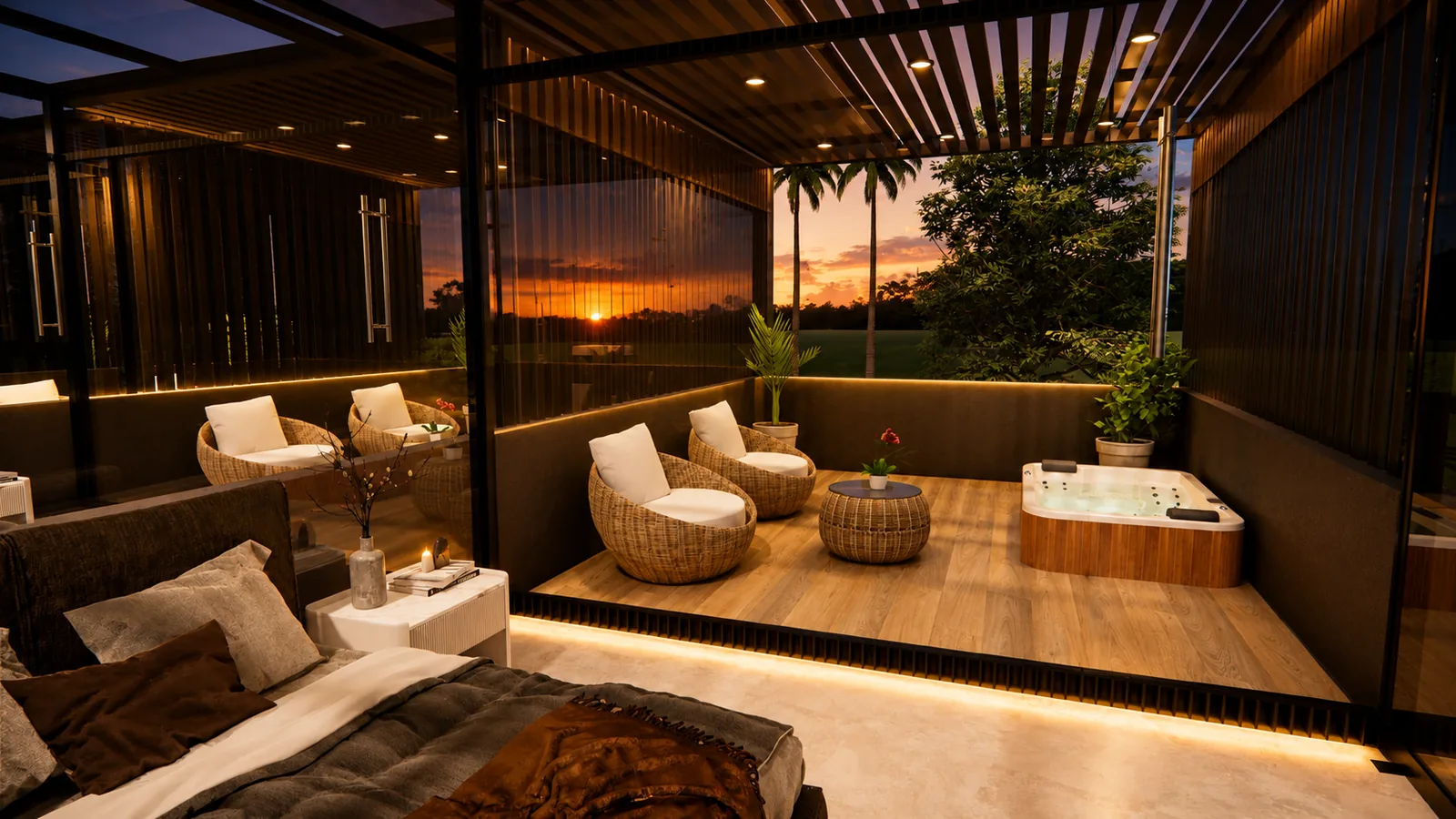
We put our own property against the most boring option a Mumbai buyer has — a bank fixed deposit — and we are publishing both answers, including the one where we lose.
The simple version first
A Glass Resort Suite costs ₹75 Lakhs. We pay you a fixed ₹21,000 to ₹35,000 every month, written into the agreement. Over ten years that adds up to between ₹25 lakh and ₹42 lakh in rent.
Now put the same ₹75 lakh in a ten-year bank FD instead. At around 6.5%, it grows to about ₹1.41 crore. That is roughly ₹66 lakh of interest.
Side by side on those numbers, the FD wins. We are not going to pretend otherwise.
But then tax happens
Those are the numbers before tax, and the two are taxed very differently.
FD interest is taxed fully. Every rupee of it, at your normal rate. Nothing is protected.
Rent is not. The government lets you knock 30% off rent before tax is even calculated, automatically, without any bills. So roughly a third of your rent is never taxed at all.
Once you allow for that, at a 30% tax rate:
- The FD's ₹66 lakh of interest becomes about ₹42 lakh in your hand.
- The rent of ₹25–42 lakh becomes about ₹20–33 lakh in your hand.
Much closer now. And there is one more difference that matters more than all of this.
The FD ends. The suite does not.
After ten years the FD gives you your money back and closes. That is it. It is over.
The suite paid you rent for ten years and you still own the suite.
So the fair comparison is not rent against interest. It is: what the FD leaves you with, against the rent you collected plus a property you still own.
Work that through and the answer is this: the suite only needs to go up in value by about ₹9 lakh to ₹22 lakh over ten years to match the FD. On a ₹75 lakh property, that is roughly 1% to 2.6% a year.
An example only. Assumes a 30% tax rate and a 6.5% FD, and gives the suite no price growth at all. The dotted box is unknown — not a promise.
Why we will not promise you a growth number
It would be easy to write "land here has gone up 12% a year" and make the total look wonderful. We will not, because nobody can honestly promise what a property will be worth in ten years. A guess printed as a number is the most common way these brochures mislead people.
What we will tell you is the bar it has to clear: about 1% to 2.6% a year. That is a low bar for an area getting a new expressway and railway line. But it is still a bar, not a certainty. If this area stops growing, the FD wins.
The part no calculation captures
An FD does not have a swimming pool.
Over ten years, this is somewhere your family actually goes. Every weekend you spend there is a weekend you did not pay a resort for. If you would take even a few short breaks a year anyway, that is real money saved — and it all sits on the property's side.
But be honest with yourself. If you know you will never actually use it, then you are buying a pure investment, and you should judge it purely on the numbers above — where it is close to an FD, not miles ahead of one.
The risks, said plainly
We have to still be here. A fixed rent is only as good as the company paying it. Ask how long we have been running, how many homes we already look after, and what the agreement says if we ever stop. That is a fair question. Ask it.
Property is slow to sell. You can break an FD in one morning. Selling a resort suite can take months, at whatever price the market gives you that day.
More villas keep opening. That puts pressure on rents across this whole area, ours included.
So how do you decide?
If you want certainty, easy access to your money, and zero involvement — an FD is a perfectly sensible answer, and we would rather you heard that from us than found out later.
If you want something you still own at the end, rent that is taxed more kindly, a low bar for growth, and somewhere your family can actually go — that is the case for the suite. It holds up without us exaggerating anything.
And if the problem is finding ₹75 lakh in one go rather than the logic, the same suite is available on a monthly plan. We have explained exactly how that works, and what it is not.
*Example figures for comparison only, September 2026. Assumes a 30% tax rate, a 6.5% ten-year FD, and the 30% automatic deduction on rent. FD rates differ between banks. Tax depends on your own situation — see our simple guide to second-home tax and talk to a CA. No price growth is promised or implied. Rent figures are part of the registered agreement and can change.
Want this done on your own numbers?
Your tax rate, your timeline, whatever you would otherwise invest in. We will work it out honestly — including if the answer is that you should keep the FD.
Talk to our team →