
If you are planning a monsoon getaway near Mumbai or thinking of buying a home in the Kasara and Igatpuri hills, here is what the four wettest months of the year actually look like on the ground.
What happens to the Kasara and Igatpuri belt from June to September
Most Mumbai families know the monsoon as grey skies, waterlogged roads, and damp laundry. Two hours away, where the plains meet the Sahyadri foothills at Kasara and climb up to Igatpuri, the same rain does something very different.
From June to September, the brown hills turn bright green within ten days of the first showers. Low clouds sit in the valleys. At Kasara and Igatpuri, mist rolls right up to the porch in the morning. The air drops several degrees cooler than the city, and you need a light blanket at night.
This is why the Mumbai to Nashik corridor has become a favourite monsoon getaway near Mumbai. You do not have to sit in the Lonavala expressway traffic jam to see a waterfall.
The best monsoon spots around Kasara and Igatpuri
When you stay in or around Kasara and Igatpuri during the rains, the best part is the drive itself. You do not need an itinerary packed with tourist traps. Still, if you want to step out with the family between showers, a few well known places are worth your time.
- Kasara Ghat: The climb from Kasara up towards Igatpuri is lined with dozens of seasonal waterfalls that appear right beside the highway and the railway tracks.
- Camel Valley: Located just before you enter Igatpuri, this valley drops sharply with multiple waterfalls cascading down the rock face when the rain is heavy.
- Bhatsa River Valley viewpoint: On the Kasara Ghat, this viewpoint gives you a wide look over the river and the green hills wrapped in fog.
- Vihigaon Waterfall: A popular monsoon cascade near Kasara surrounded by forest, best viewed from a safe distance when the water flow is strong.
- Bhandardara and Arthur Lake: A drive further into the hills past Igatpuri takes you to Arthur Lake, the Wilson Dam, and Randha Falls in full flow.
How to stay safe when the rain gets heavy
The Sahyadris are beautiful in July and August, but heavy mountain rain needs respect. If you are taking your family up for the weekend, a few plain rules keep everyone safe.
First, drive in daylight. Kasara Ghat gets thick fog after dark and during heavy downpours, which drops visibility to a few metres. Leave Mumbai in the morning so you reach before late afternoon. Remember that Kasara is also the final local train station on the Central line, so the rail route is always there if you do not feel like driving.
Second, enjoy waterfalls from a distance. Flash floods happen in the hills when it rains heavily upstream, even if it is only drizzling where you are standing. Never let children or adults walk into fast moving water or climb wet, moss covered rocks.
Third, stay on marked forest trails. At our Kasara community, we have internal forest trails and a bonfire deck for dry evenings, so families can enjoy the outdoors within a secure boundary with 24 hour security.
What the monsoon does to an unmanaged house
Visiting for a weekend is one thing. Owning a house in a heavy rainfall belt is another. Every builder brochure shows a sunny pool, but nobody talks about August.
In the Sahyadri foothills, four months of continuous rain will test every brick and pipe. If a standalone house is locked up from Monday to Friday with nobody watching it, three things happen.
Grass and weeds grow waist high in three weeks and invite snakes and insects. Dead leaves clog roof drains and gutters, which pushes rainwater against the walls and causes damp patches inside. Swimming pools collect rainwater, leaves, and mud, turning green if the filtration pump and chemical balance are not checked every couple of days.
If you own an independent farmhouse, you spend your Friday night cleaning up after the rain instead of resting. Or you pay a local caretaker who may or may not show up when it pours.
How a managed villa works in the rains
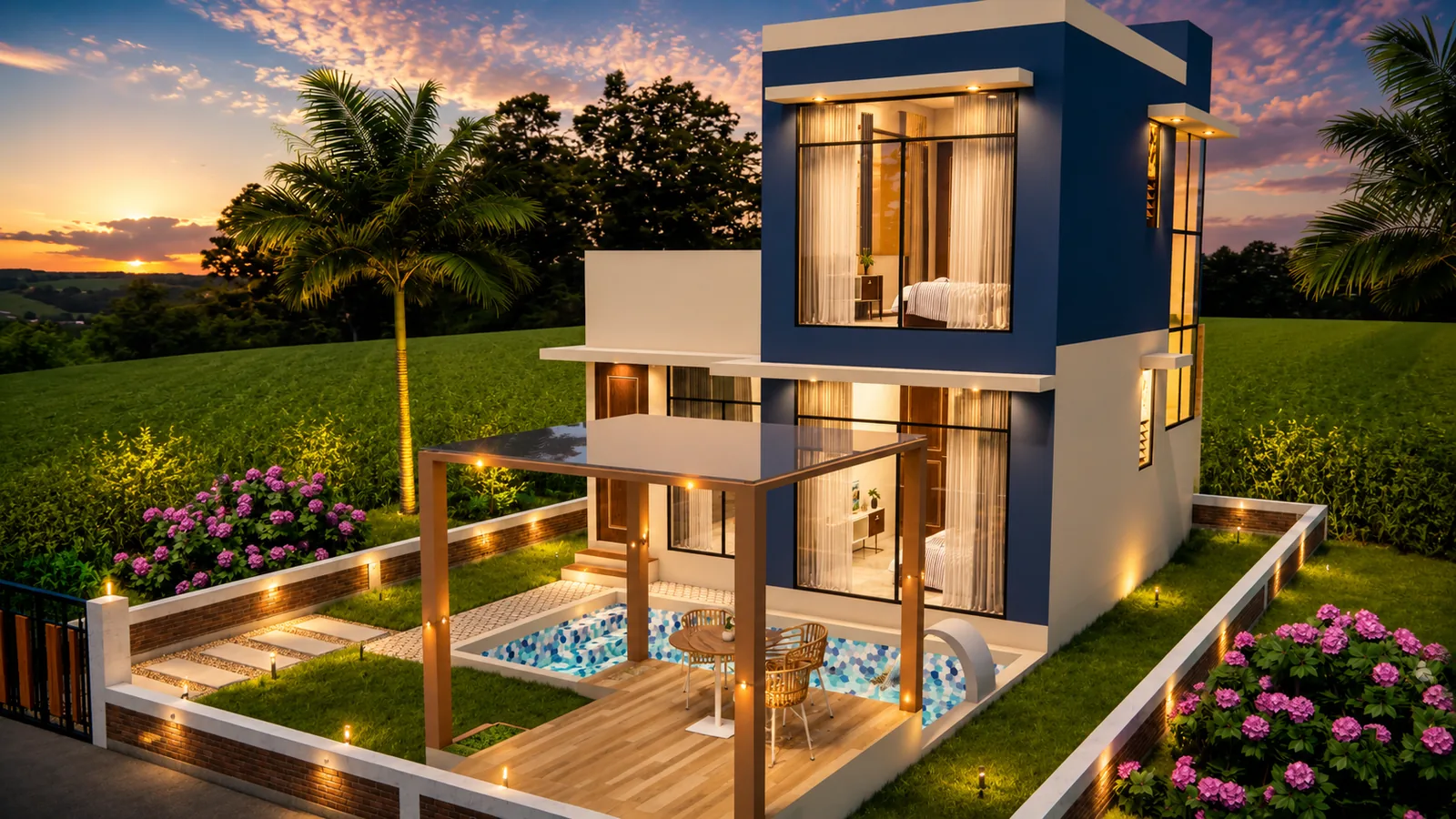
This is why we build managed communities rather than leaving buyers on their own. At Kasara, our pool villas start at ₹1.09 Cr onwards, and the upkeep is managed by our team.
When it rains, the maintenance staff clears the storm drains, trims the garden, checks for leaks, and keeps the private pool clean. You do not have to call a plumber from Mumbai.
The monsoon is also a busy season for weekend guests looking for a monsoon getaway near Mumbai. For owners at Kasara, the rental programme pays an assured rent of up to ₹40,000 a month, written into the registered agreement. On a ₹1.09 Cr villa, ₹40,000 a month works out to ₹4,80,000 a year, which is about 4.4% a year before tax. You receive that amount every month whether your villa was booked on a rainy Tuesday or stood empty.
If you look slightly further up the ghat at our 10,000 sq ft estates in Igatpuri, or towards Khardi, those homes can earn seasonal rental income when guests visit for the rains, though those figures are illustrative and vary with bookings rather than being a fixed monthly sum.
Why you should visit a site in July or August
Most people wait for the rain to stop in October before they go looking at second homes. We tell families to do the exact opposite.
Turn a monsoon drive into a site visit and see the site when it is pouring. Look at the approach road to see if it holds water. Look at the slope of the land and ask where the rainwater drains. At Kasara, our foundation and structure work is currently underway, and seeing a site in the wet season shows you the real climate and the real drainage.
Before you buy anywhere in this belt, ask the developer two questions. Ask who cleans the pool and the roof gutters in July, and ask to see the registered agreement that spells out the maintenance and the rent. Registration details are shared per project on request.
Read next
- Mumbai to Igatpuri and Kasara: Drive and Train Guide
- Holiday Home Maintenance: Who Looks After It?
- What to Check on Site Before You Buy a Villa in Kasara
- See Kasara, with prices and photos
*T&C apply. Prices, payment plans and rental income are as per the registered agreement and can change. Rental and investment figures for Khardi and Igatpuri are illustrative and not guaranteed.
See Kasara for yourself
Ask us for current construction photos, the drive map from Mumbai, or the rental agreement terms.
WhatsApp usCall +91 70426 33644Other ways to reach us