
A dirt track you drove on during a site visit is not proof of legal access. Here is how to verify the right of way to land in Maharashtra before you pay a rupee.
Why a path on the ground is not enough
When you drive out from Mumbai or Thane to see a plot, you usually follow the broker's car off the highway and onto a smaller track. You reach the land, step out, and assume the road you just drove on is the road to your future home. That assumption is one of the most expensive mistakes a land buyer can make.
In Maharashtra, a physical path that people use today is not the same thing as legal access. The track you drove on might cross a neighbour's private survey number. The neighbour may let villagers walk or ride bikes across it out of goodwill, or because the land is currently empty.
The moment you buy the plot and bring in a truckload of bricks to build a compound wall, that goodwill can end. If the road is not recorded in government papers or in a registered deed, the neighbour can legally put up a fence and block your car. A plot without recorded road access often struggles to get building permission or a bank loan, and is hard to resell.
The papers that actually prove road access
You do not verify a road with your eyes on a Sunday visit. You verify it on paper before you pay a booking amount. Depending on whether you are looking at a single plot or a gated layout, your lawyer will check four specific documents to confirm a clear right of way to land.
Each paper tells a different part of the story, and they must match what you see on the ground.
- The village map (gav nakasha): This is the official revenue map of the village. It shows the boundaries of every survey number and marks public village roads, boundary tracks (shiv rasta) and traditional cart tracks (pandhan rasta). If a public road touches your plot, it will show up here.
- The 7/12 extract: This land record sometimes notes existing pathways, public roads or rights held by others in the other rights column. It is a useful cross check alongside the village map.
- The sanctioned layout and NA order: If you are buying a non agricultural plot, the NA order or NA permission and the sanctioned layout map are the most important papers. They must show the approved approach road reaching the layout and the exact width of the internal roads touching your specific plot number.
- A registered right of way deed: If a plot does not touch a public road and can only be reached by crossing someone else's private land, there must be a registered easement deed.
What an easement or right of way is
Sometimes a good piece of land sits one plot back from the main village road. To reach it, you have to drive across a strip of the front owner's land. In law, this legal right to cross another person's property to reach your own is called an easement or a right of way.
For this access to be safe, it cannot be an oral promise or a casual letter on stamp paper. It has to be a registered right of way deed, signed by the owner of the front land and recorded at the sub registrar's office. Ideally, this right should also be entered in the revenue records of both plots so any future buyer of the front land knows the road exists.
Your lawyer should read the exact wording of the deed. It needs to say clearly that the right is permanent, that it passes to future buyers of your plot, that it allows four wheelers and construction vehicles, and that it lets you lay water pipes and electricity cables underneath or alongside the road.
What the Tahsildar can and cannot do
When a buyer points out that a plot has no road on the map, some sellers wave it away. They say you can buy the land cheap today and file a simple application with the Tahsildar tomorrow to get a government road order. Do not fall for this.
Revenue officers do have specific powers under two laws, the Maharashtra Land Revenue Code and the Mamlatdars' Courts Act, 1906. Under the Maharashtra Land Revenue Code, the Tahsildar can decide claims by agricultural landholders who need a right of way along the boundaries of neighbouring survey numbers to farm their fields. Under the Mamlatdars' Courts Act, 1906, the Mamlatdar or Tahsildar can order the removal of a recent fence or wall that blocks an existing way.
Notice the limits in both laws. A 2026 Bombay High Court ruling made it clear that the Mamlatdars' Courts Act, 1906 cannot be used just to demand a new, more convenient road over someone else's land. You have to prove that an existing way was already there and was blocked. Courts have also stated that the Tahsildar's power to grant boundary access is meant for agricultural land, not to create a wide road for a non agricultural weekend home plot.
In short, you should never buy a landlocked plot hoping to win a road later through a court or revenue case. If the legal road is not on paper before you buy, walk away.
How road access works in a gated plot layout
For most Mumbai families, buying an individual plot in a village and fighting over boundary tracks is not worth the headache. That is why many buyers prefer a sanctioned, gated township where the road work is already done.
Even in a gated project, you should still check the papers. Ask for the sanctioned layout map approved by the town planning authority. Check that the main gate connects directly to a public road shown on the village map. Then trace the internal roads from the gate all the way to the plot number you want to buy, and check who maintains those roads once the project is running.
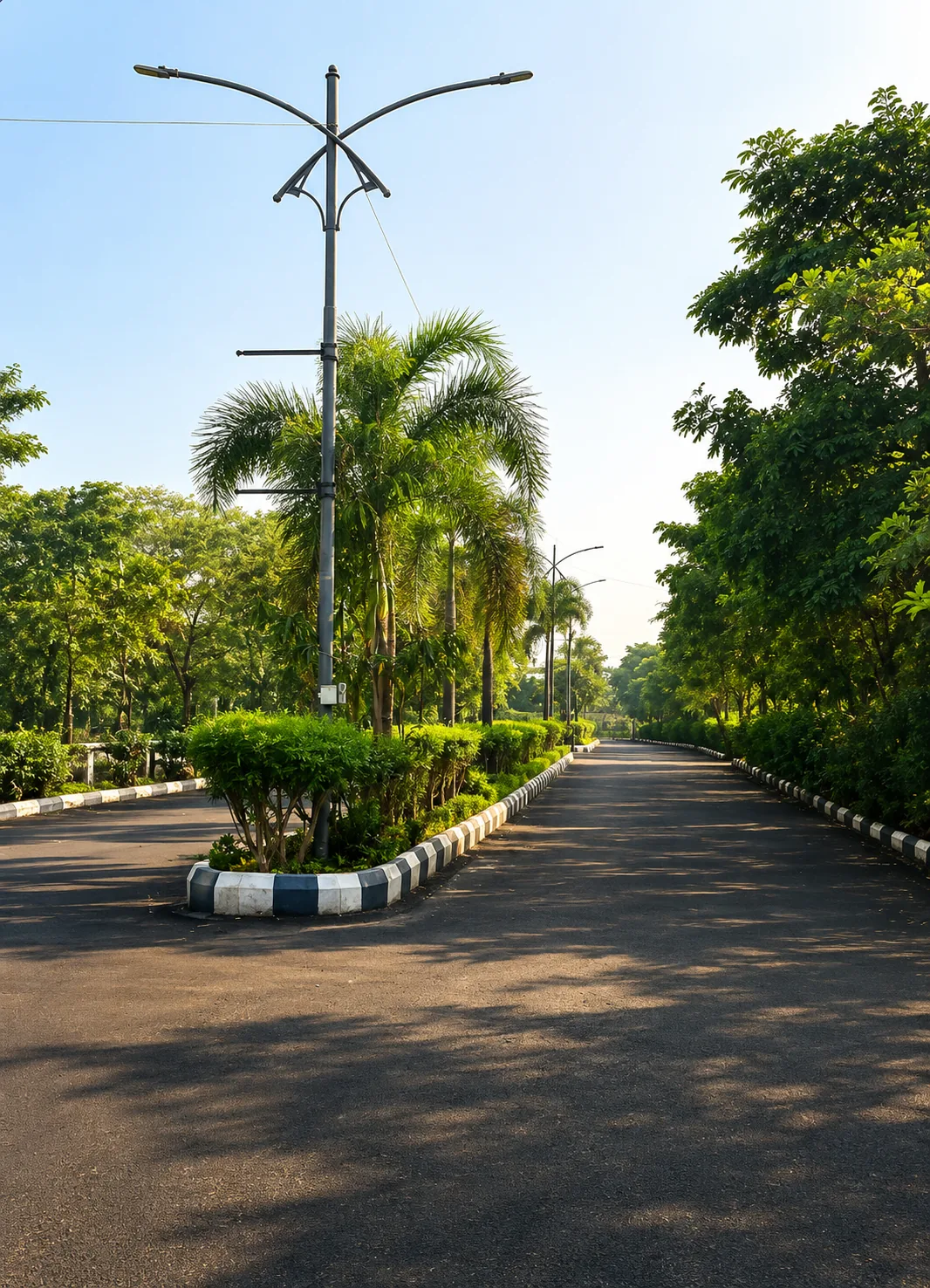
For example, at Nature's Nest by Pool City at Atgaon, we offer plots in a 27 acre gated township of 277 freehold non agricultural plots. The layout is approved by the competent authority, and the internal tar roads on 9 m and 12 m alignments are already built with LED street lights and underground drainage. Plots start from ₹49 lakh for 2,260 to 3,900 sq ft, and select plots come with a ₹50,000 a month payment plan. At our 10,000 sq ft private estates in Khardi (from ₹3.25 Cr) and Igatpuri (from ₹4.25 Cr), the estates are built on non agricultural plots.
Even when the roads are tarred and lit in front of you, the rule stays the same. We show every document, and we advise every buyer to have their own independent lawyer verify the title, the sanctioned layout and the road access before booking.
Five checks to do before you pay a token
Whether you buy from us or anyone else along the Mumbai to Nashik corridor, run through this simple checklist before you hand over a cheque. These five steps can save you years of trouble over the right of way to land.
- Ask for the village map (gav nakasha) and trace the public road right up to the outer boundary of the project or plot.
- If it is an NA plot, match the internal roads on the ground with the roads drawn on the sanctioned layout map and read the conditions in the NA order.
- Check that the road is wide enough on paper and on site for two cars to pass and for a fire engine or construction truck to turn.
- If any part of the approach crosses private land outside the project, ask for the registered right of way deed and have your lawyer read it.
- Never accept a verbal assurance that a road is being negotiated with a neighbour or awaiting a Tahsildar order. Only buy what is already legal and recorded.
Read next
- How to Check a Plotted Project Before Buying Near Mumbai
- NA Order Meaning in Maharashtra: A Plot Buyer’s Guide
- Freehold, NA, Clear Title — What Actually Matters When You Buy Land Near Mumbai
- See all Pool City projects, with prices and locations
*This article is general guidance for plot buyers in Maharashtra and is not legal advice. Laws and court rulings apply to the specific facts of each land parcel. Always have an independent property lawyer check the title, village map, NA order and access deeds before you pay. For Atgaon: Payment facility offered by the developer. Not a loan, a credit facility or an assured return scheme. Terms apply.
Want to see what a sanctioned layout looks like on paper and on site?
Come and walk the tarred roads at Atgaon or inspect the sanctioned layout papers with our team before you decide.
WhatsApp usCall +91 70426 33644Other ways to reach us